
Children’s Eye Exams That Catch What School Screenings Miss
Pediatric Eye Exam FAQs
Your Child's Vision Affects More Than How Clearly They See
Children do not always know their vision is blurry. They adapt—sitting closer to the board, losing interest in reading, struggling in school—without being able to tell you why.
- 1 in 4 children has an undetected vision problem that affects their ability to learn
- School screenings miss up to 60% of vision problems—passing a screening does not rule out an eye condition
Dr. Alexa Gutierrez sees children of all ages at FocusVision and has established relationships with local pediatricians and schools in the Longmont area.
What Happens at a Pediatric Eye Exam
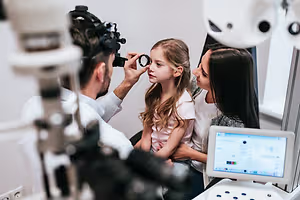
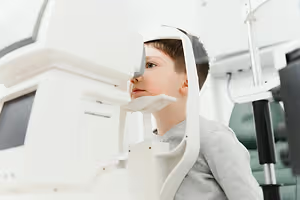
A pediatric eye exam at FocusVision evaluates far more than a school vision screening. For younger children who cannot yet read, we use non-verbal testing methods that do not require identifying letters. Dr. Gutierrez takes the time to put children at ease and explain findings to both parents and kids.
Myopia Evaluation and Management for Children
If your child's prescription keeps getting worse, stronger glasses are not the answer; they correct the vision but do nothing to slow the progression. Myopia that advances unchecked increases the risk of serious eye conditions in adulthood, including retinal detachment and glaucoma.
Dr. Gutierrez is certified in the Brilliant Futures™ MiSight® Program, one of the few FDA-approved treatments designed to slow childhood myopia progression. A consultation will determine whether your child is a candidate based on their age, prescription, and rate of change.
Most children should have their first comprehensive eye exam between 6 and 12 months. A second exam is recommended between ages 3 and 5, before starting school. After that, annual or biennial exams are recommended through the school years, as this is when myopia most commonly develops. If your child has a known risk factor or shows signs of a vision problem, earlier or more frequent exams may be recommended.
No. School vision screenings test only basic distance visual acuity, whether your child can see the chart at 20 feet. They do not evaluate near vision, eye coordination, eye health, depth perception, or color vision. Studies suggest school screenings miss up to 60% of vision problems. A comprehensive exam at Focus Vision evaluates all of these areas and provides a complete picture of your child's visual health.
Myopia (nearsightedness) in children can often be managed, not just corrected. Dr. Alexa Gutierrez is certified in the Brilliant Futures™ MiSight® Program, an FDA-approved daily contact lens therapy that has been clinically shown to slow the progression of myopia in children. A myopia management consultation will determine whether your child is a candidate. Call (303) 651-2020 to schedule.
Yes. For children who cannot yet read, we use non-verbal testing methods, including picture charts, preferential looking tests, and other age-appropriate techniques that do not require the child to identify letters. Dr. Gutierrez takes the time needed to get accurate results from patients of any age.
Infants & Toddlers (0–2 Years)
Children should have their first comprehensive eye exam between 6 and 12 months of age. Early exams check for conditions like amblyopia (lazy eye) and strabismus (eye turn) that are most treatable when caught before age 3. Your pediatrician may refer you sooner if concerns arise.
Preschool (3–5 Years)
School-Age Children (6–12 Years)
School-age children should have a comprehensive eye exam every one to two years. This is when myopia most commonly develops and progresses. Passing the school vision screening is not sufficient; screenings miss a significant number of vision problems that a comprehensive exam catches.
Teenagers (13–18 Years)
Signs Your Child May Need an Eye Exam
Children rarely complain about their vision because they do not know what clear vision feels like. Watch for:
Schedule Your Child’s Eye Exam in Longmont
Dr. Alexa Gutierrez sees children of all ages at FocusVision's Longmont eye clinic, located at 1630 Hover Street, Suite A. We are open Monday through Friday, 9:00 AM to 5:00 PM. Call (303) 776-1620 or book online to schedule your child's eye exam. If you have concerns about myopia progression or want to discuss MiSight®, ask for a myopia management consultation when you schedule.