
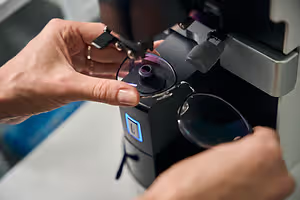
Lens Treatments and Coatings at FocusVision
Lens Treatment FAQs

Lens Treatments That Improves How Your Glasses Perform
Most patients think about lens treatments as add-ons chosen at the end of the eyewear process. At FocusVision, they are part of the optical recommendation your eye doctor makes based on how you use your eyes, what your prescription requires, and what your daily environment demands.
- Treatments applied by our optical lab partner—your lenses are finished to your exact prescription before being returned for fitting.
- Recommendations matched to your prescription and lifestyle—not a standard package applied to every patient.
Because FocusVision coordinates lens manufacturing through our trusted optical lab partner, the quality of your coatings meets consistent, verified standards. When something needs to be corrected or adjusted, it is handled promptly—most coating failures patients experience happen when finishing is rushed or inconsistent at a remote lab.
Which Treatments Are Right for Your Lifestyle?
The right combination of treatments depends on your prescription, your primary activities, and your lens material. A patient with a strong progressive prescription in high-index lenses has different treatment priorities than a child in polycarbonate single vision lenses, or an adult managing glaucoma who needs maximum contrast in low-light conditions.
Patients who spend significant time on screens benefit most from AR coating and blue light filtering. Patients who drive regularly, particularly at night on Longmont’s roads and in mountain conditions, benefit most from AR coating. Patients who move between indoor and outdoor environments throughout the day find Transitions® lenses eliminate the need to manage a separate pair of sunglasses for daily tasks.
If you spend most of your workday in front of a computer, phone, or tablet, anti-reflective coating and blue light filtering are the two treatments that will make the most practical difference. AR coating reduces glare from screens and overhead fluorescent lighting. Blue light filtering lenses reduce exposure to high-energy visible light from digital displays. Together, they make prolonged screen time more comfortable without affecting how your lenses look or perform.
Colorado's combination of high altitude, intense sun, and variable conditions makes UV protection and Transitions® lenses particularly practical for patients who spend significant time outdoors. UV exposure increases with elevation, and moving regularly between bright outdoor light and indoor environments makes photochromic lenses a convenient single-pair solution. Scratch-resistant coating is also worth considering for patients whose glasses are exposed to trail dust, wind, and physical activity.
Anti-reflective coating is one of the most impactful treatments for drivers, particularly for night driving. Oncoming headlights and overhead streetlights create glare that reflects off untreated lens surfaces and reduces visual clarity. AR coating significantly reduces this. Transitions® lenses also provide automatic sun protection during daytime driving without requiring a separate pair of sunglasses.
For children and active patients, polycarbonate lenses are the most practical lens material, impact-resistant and lighter than standard plastic. Pairing polycarbonate with scratch-resistant coating and UV protection addresses the three most common ways children’s glasses get damaged or compromise eye health. These treatments extend the life of the lenses and ensure the glasses continue protecting your child’s eyes even when they are not being handled gently.
Lens Materials That Work With Your Treatments
The lens material you choose determines how well your treatments actually work for your eyes and your life. Choosing the right material isn't just about weight or thickness—it affects how clearly you see, how long your lenses last, and how comfortable your glasses feel every day.
Anti-Reflective Coating
Photochromic Lenses (Transitions®)
Blue Light Filtering Lenses
UV Protection and Scratch-Resistant Coating
All Lens Treatments Available at FocusVision
All of the following lens treatments are available at FocusVision and can be applied to most lens types. Your optician will recommend the combinations that make the most sense for your prescription, frame choice, and daily routine.
- High-index lenses—thinner and lighter than standard plastic; recommended for stronger prescriptions.
- Polycarbonate lenses—impact-resistant and lighter than standard plastic; recommended for children. and active patients.
- Digital freeform lenses—custom-calculated progressive designs for sharper peripheral vision.
Discuss Your Lens Options at Your Next Appointment
Lens treatment decisions are part of your eyewear consultation at FocusVision. After your eye exam, your optician will walk you through the options that make sense for your prescription, your lens material, and the way you use your eyes every day. Because FocusVision works directly with our optical lab partner on every order, there is no guesswork about how treatments are applied and if anything needs to be corrected, it is handled promptly. Call (303) 776-1620 or book online to schedule your appointment.